Role: Director of Design (UX strategy, systems design, and hands-on IC execution)
Company: NFI Industries (Relay TMS)
Timeframe: 2019–2024 (platform evolution and scale)
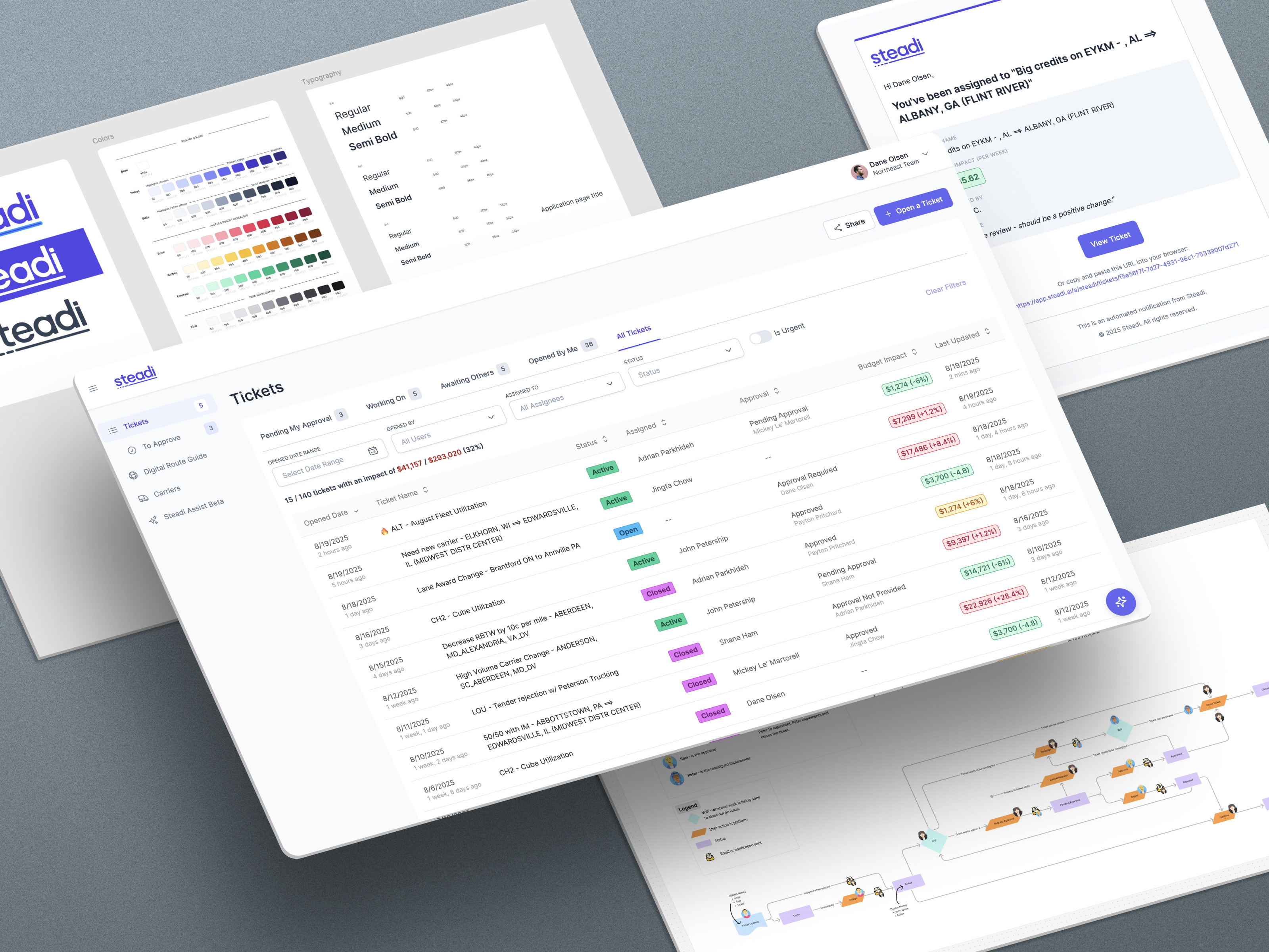
The Hub was a core workspace within NFI’s proprietary Transportation Management System, supporting Account Managers responsible for planning, monitoring, and executing freight at scale.
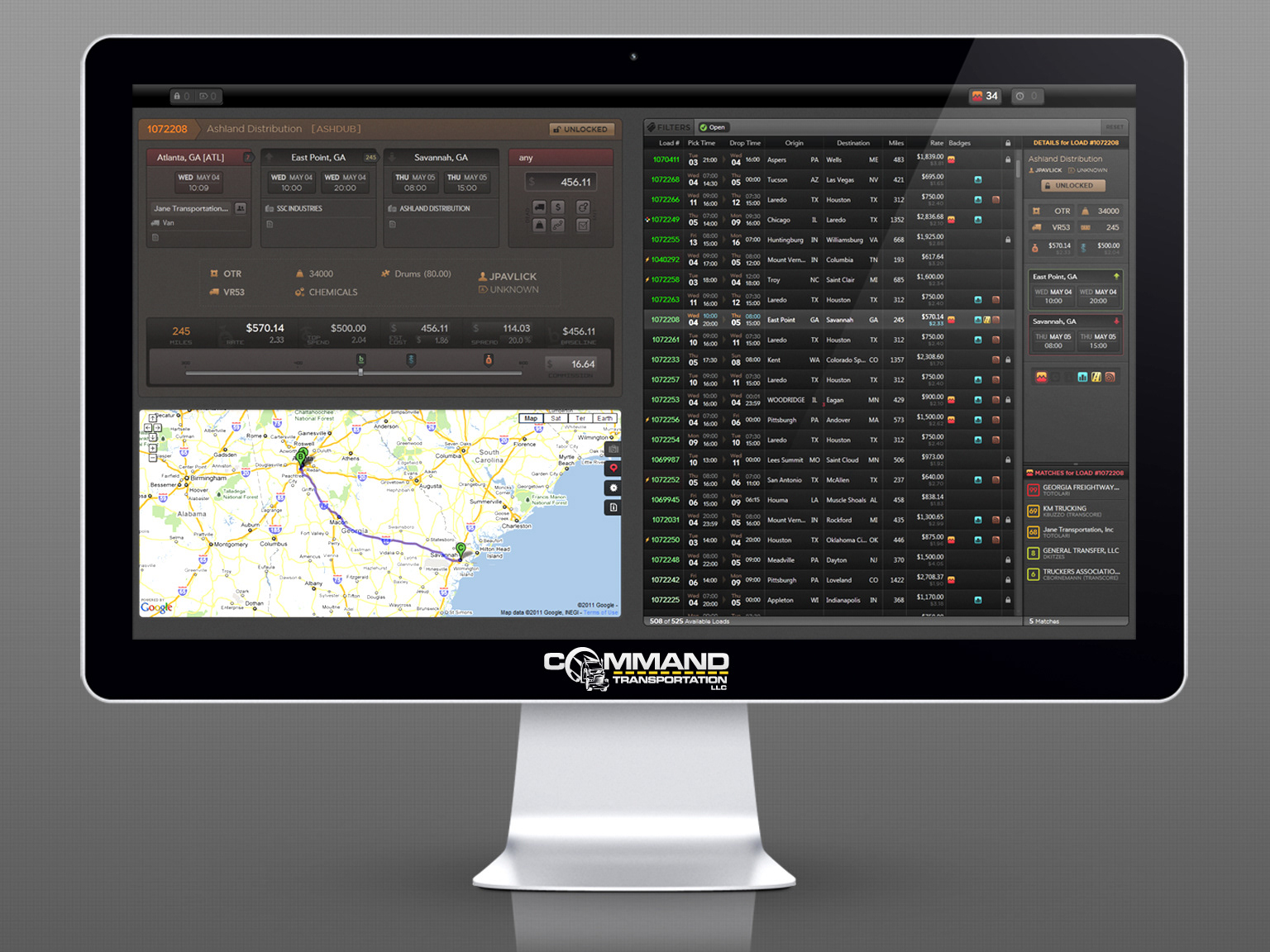
As the platform grew, it began to inherit the same failure modes common to legacy logistics systems. Dense, table-heavy interfaces exposed large volumes of data but made it difficult to understand what actually required attention.
The goal was not to add more visibility. It was to create a state-aware, workflow-driven system that made urgency, risk, and next actions immediately clear.
At its best, The Hub made it immediately clear what required attention, why it mattered, and what to do next.
The Problem
As NFI’s brokerage platform scaled, the account management experience began to mirror incumbent TMS products: dense, table-driven interfaces attempting to serve every role equally at all times.
While functional, this approach buried urgency, obscured liability, and forced users to manually triage work across hundreds of active loads.
Account Managers needed a system that reflected how the day actually unfolds, not a static snapshot of everything that exists.
My Role
I led product design for the brokerage TMS at NFI, serving as both the design lead and a hands-on individual contributor across the evolution of The Hub.
My role spanned discovery through delivery, partnering closely with Account Managers, product, and engineering to understand how work actually happened, identify where confidence broke down, and translate those insights into a more structured, scalable system.
In practice, I operated as a systems-oriented IC. I defined core interaction models such as the Load Signature and state-based workflows, shaped the product’s information architecture, and drove high-fidelity design through implementation to ensure complex workflows remained clear, consistent, and shippable as the platform grew.
Discovery & Framing
As NFI’s brokerage platform scaled, Account Managers were struggling with work prioritization and with confidence when responding to customers. Despite having access to extensive load data, it was often unclear which loads required attention now, which were stable, and which posed hidden risk.
Early discovery focused on mapping how Account Managers and their supporting operational staff experienced a day: morning planning, active execution, and late-stage exception handling. Across interviews, shadowing, and platform analytics, consistent patterns emerged. Uncertainty surfaced at moments of handoffs and escalations. Stale information was present across the system when corresponding with customers and no visible audit trails were easily accessible without communication outside of the TMS.
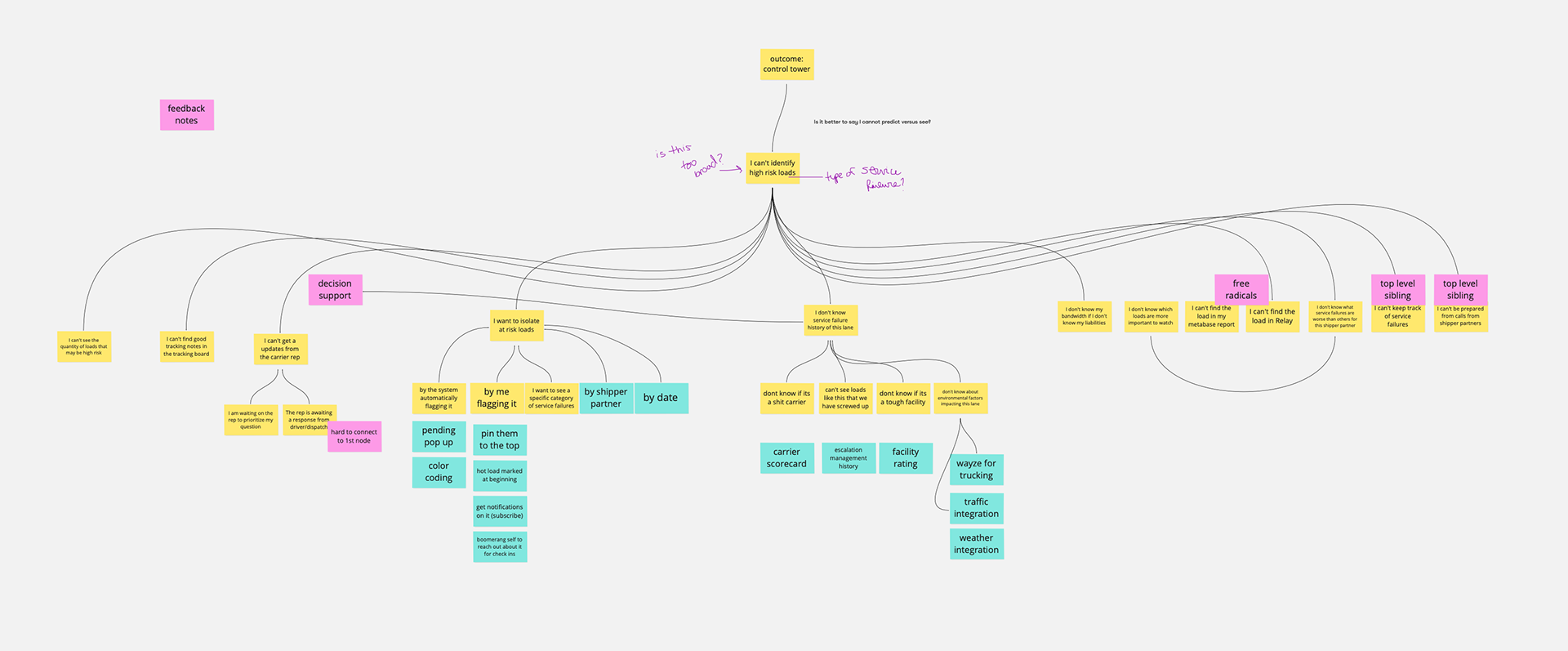
To explore this further, we used an Opportunity Solution Tree to shift the conversation away from features and toward outcomes. Rather than asking how to improve tables or filters, we focused on where confidence broke down and what signals could restore it. This led us to prioritize opportunities centered on liability, timing, and ownership.
One opportunity quickly rose to the top: “I want to see all the uncovered loads that I am responsible for."
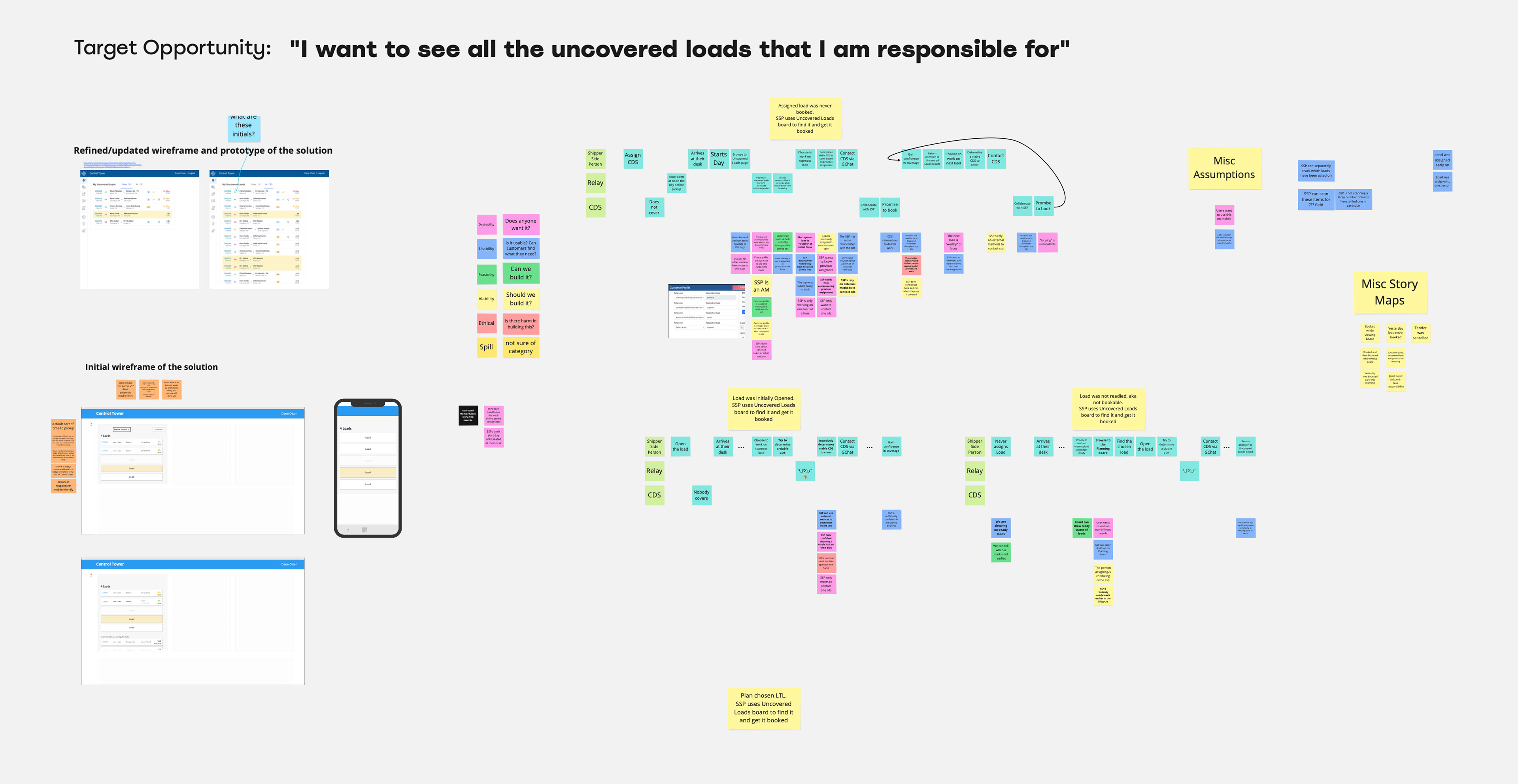
This framing was deliberately narrow. It forced clarity around responsibility, surfaced operational risk, and created a concrete entry point for improving daily decision-making without overwhelming users.
These insights shaped the foundation of The Hub. Rather than acting as another reporting surface, it became a state-aware workflow designed to surface risk at the right moment, guide next actions, and preserve deep context only when needed.
The problem wasn’t visibility — it was knowing what mattered now.
Design Decisions
Making urgency visible without oversimplifying complexity
Making urgency visible without oversimplifying complexity
With the problem reframed around confidence and responsibility, the design challenge became clear: help Account Managers identify what required attention now without removing the depth needed for high-stakes decisions.
Several guiding decisions shaped the system:
1. Prioritize state over static status
Loads were modeled as entities moving through a lifecycle, not static records. This made progression, dependency, and risk visible at a glance.
2. Design for scanning first, investigation second
The interface emphasized rapid triage through a minimal load signature, with deeper context available on demand.
3. Surface liability, not just information
Visual hierarchy, ordering, and grouping were used to make risk explicit without requiring interpretation across multiple fields.
4. Constrain configurability to protect clarity
A strong default view ensured critical signals were always visible and reduced the risk of missed work.
5. Preserve context across handoffs
Recent activity, ownership, and history were visible by default, reducing reliance on external communication.
6. Treat the Hub as a workflow, not a report
Every element was designed to support decision-making and action, not passive observation.
Good visibility is not about showing everything. It is about making the right action obvious.
Systems Foundation: The Load Signature
A shared structure for identity, state, and action
A shared structure for identity, state, and action
As The Hub evolved into the primary workspace for account management, visual improvements alone were not enough. The system needed a stable foundation that could support fast decisions and consistent understanding.
That foundation became the Load Signature.
A load was formalized as a minimal, structured set of attributes that answered three questions instantly:
• What is this load?
• Where is it in its lifecycle?
• What needs to happen next?
This was not about completeness, it was about decision relevance.
Time became a first-class signal through readiness, deadlines, and aging, allowing urgency to be surfaced without manual effort.
By standardizing these signals, all parts of the product spoke the same language. The Hub table, detail views, pricing, and planning workflows remained consistent, reducing confusion and improving trust.
The Load Signature also aligned product and engineering through a shared lifecycle model, making the system more legible for both users and builders.
Most importantly, it created a foundation that allowed the product to grow without reintroducing complexity.
The Hub in Practice
Turning system design into everyday workflows
Turning system design into everyday workflows
While the Load Signature defined the structure of a load, its value came from how it shaped daily workflows.
Daily planning: what needs attention now
The Hub’s primary table view allowed Account Managers to immediately identify which loads required action based on state, timing, and risk.
Users could move quickly from:
what’s in my queue → what needs action now
without relying on filters or external tracking.
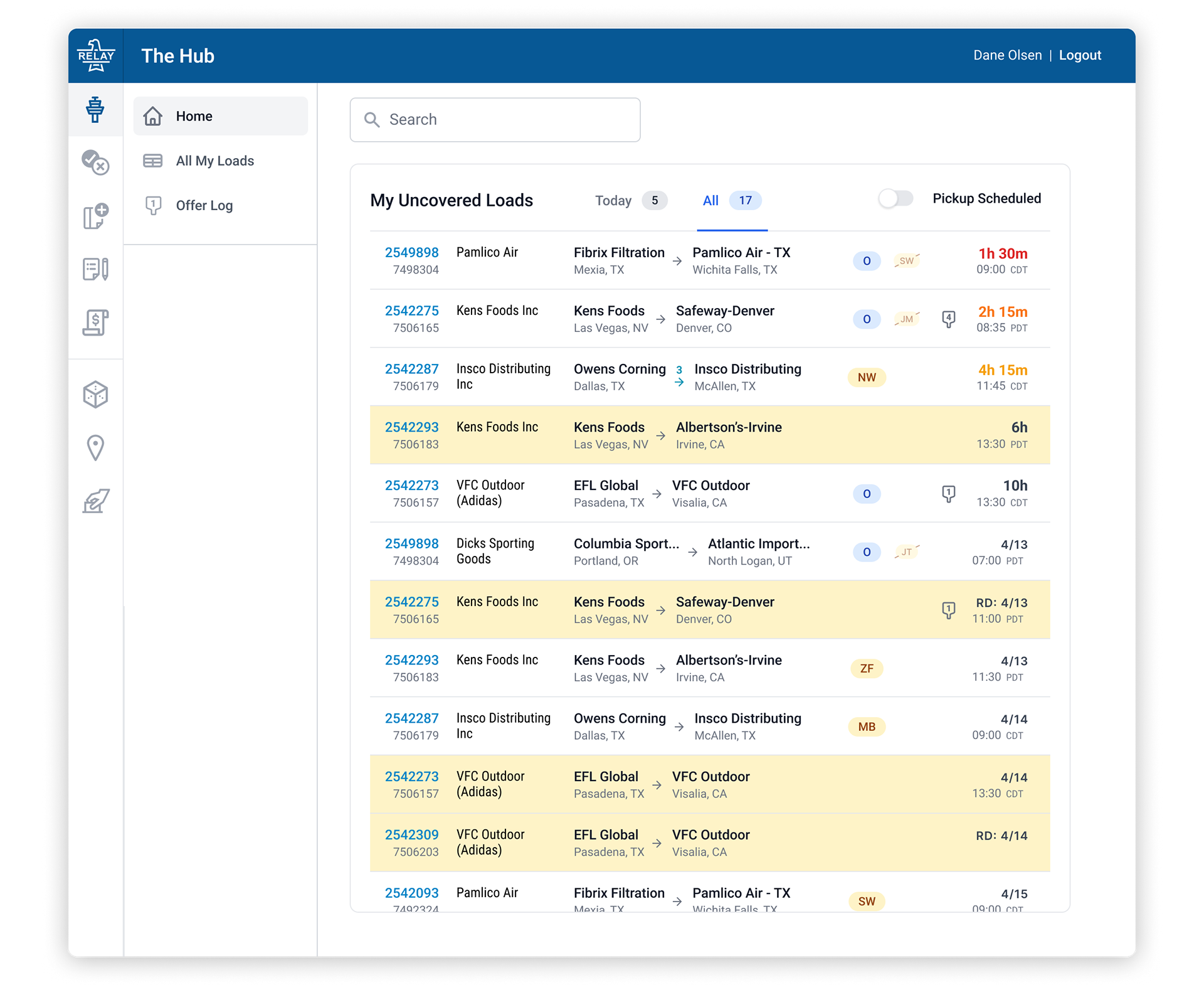
Planning view prioritizing uncovered and at-risk loads based on state and timing
Load Detail: depth without losing context
The load detail view prioritized current state, timing, and decision context while keeping deeper information accessible but secondary.
Users could understand what had happened, evaluate options, and act without losing their place in the broader workflow.
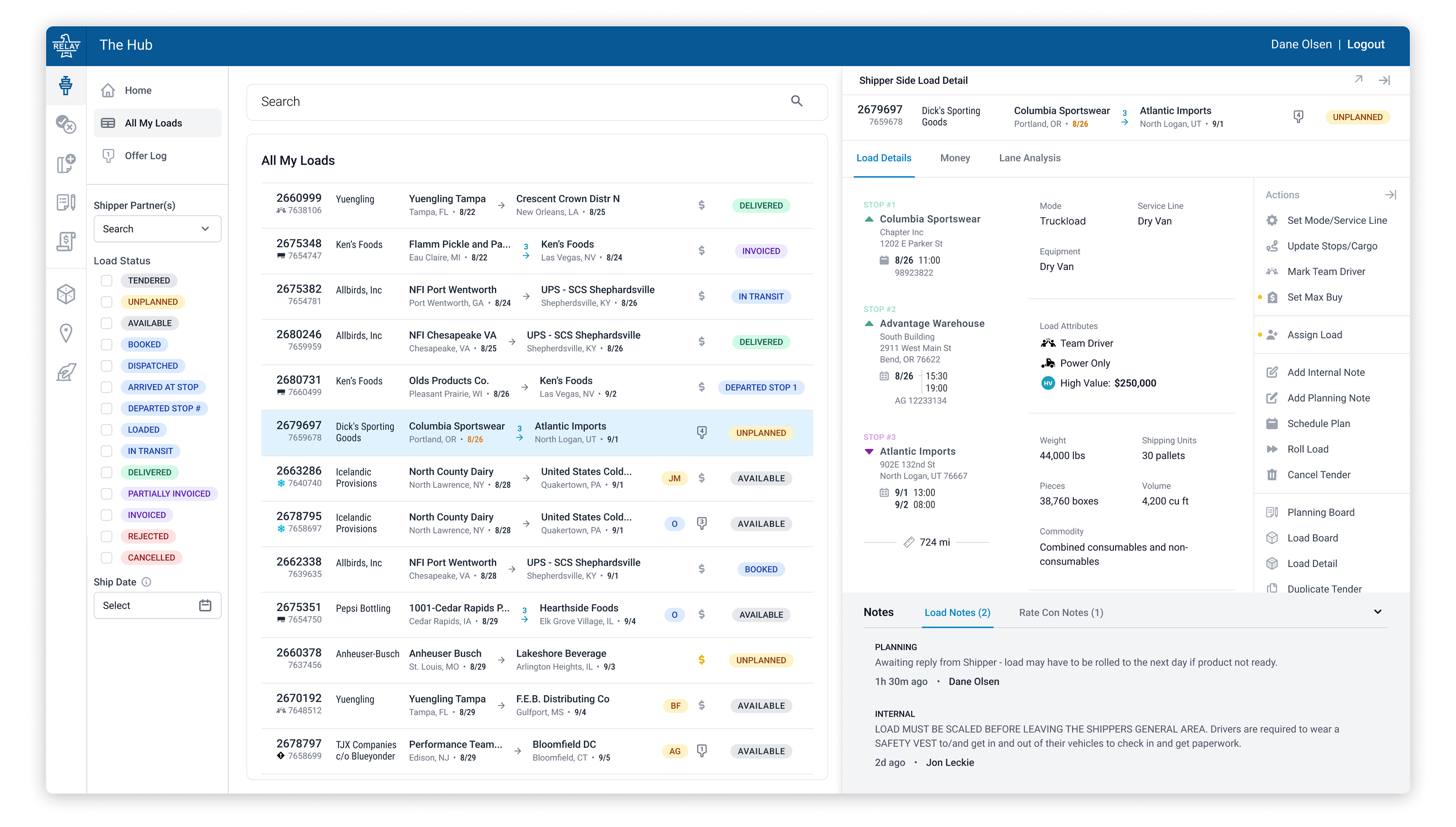
Load detail structured around state, timing, and next actions
Offers and pricing: decision support in the moment
Offer evaluation was centralized and paired with embedded benchmarks and context.
Users could compare options, understand market position, and make decisions without reconstructing information across systems.
Continuity across the lifecycle
Across all workflows, the same signals remained consistent.
The system always answered:
• What is happening?
• Why does it matter?
• What should I do next?
This reduced context-switching and allowed users to re-enter work quickly, even after interruptions.
Outcomes & Impact
Turning clarity into measurable operational gains
Turning clarity into measurable operational gains
The Hub became the primary daily workspace for Account Managers and their supporting teams at NFI’s brokerage. By grounding the experience in workflow, state, and decision relevance, it fundamentally changed how work was prioritized and executed across planning and execution phases.
The impact was both qualitative and measurable.
Increased throughput without added headcount
Clear visibility into liabilities and next actions reduced planning friction and kept work moving.
• Fewer stalled loads during morning planning
• Faster progression from uncovered to booked
• Less reliance on external coordination
Account Managers handled more loads per person without increasing staffing.
Meaningful error reduction
Many planning errors previously stemmed from missed handoffs, unclear ownership, and late discovery of risk.
By surfacing risk and responsibility earlier in the workflow:
• Load error rates dropped from ~8% to <1%
• Escalations shifted from reactive to proactive
• Late-stage surprises were significantly reduced
Critical work became difficult to miss, even under high volume.
Greater confidence in customer interactions
Account Managers could step into any load and quickly understand what was happening.
• Clear visibility into current state and history
• Faster, more confident responses to customer inquiries
• Ability to act without switching tools or reconstructing context
This improved both internal efficiency and external customer experience.
A foundation that scaled with the business
The Hub established a durable system that could evolve without reintroducing complexity.
New capabilities such as pricing intelligence, automation, and analytics could be layered onto the system without disrupting workflows or adding clutter.
The product scaled in capability while preserving clarity.
Reflection
The success of The Hub did not come from a single feature or interface. It came from treating account management as a time-sensitive, risk-aware workflow and designing for how decisions are actually made under pressure.
As the system aligned around state, timing, and responsibility, complexity became easier to manage instead of harder to navigate.
The biggest shift was not in how much information we showed, but in how clearly the system communicated what mattered.
The biggest win was helping people trust what they were seeing.